
Spatio-Temporal Hydrologic Modeling of Land Cover Change Effects on Runoff in the Kabacan Watershed, Philippines
Keywords:
Flood, HEC-HMS, Kabacan Watershed, Land Use/Land Cover, RunoffAbstract
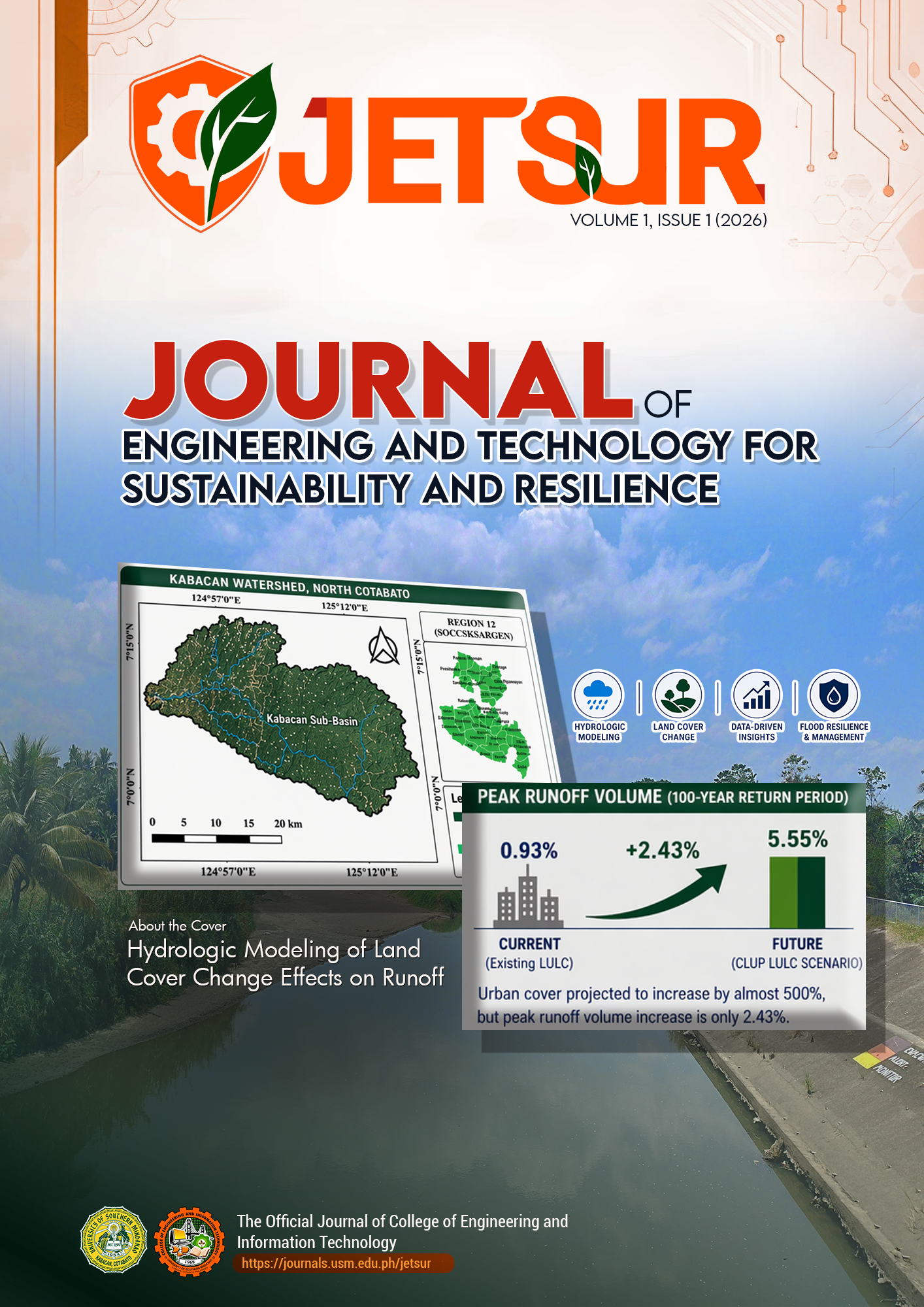
Rapid urbanization and subsequent changes in land-use/land-cover (LULC) are widely considered to contribute to more frequent and severe floods, but little is known about how vulnerable agricultural watersheds in Mindanao are in this context. This study assesses the effect of changing LULC over time and in the future Comprehensive Land Use Plan (CLUP) LULC scenario (from the respective Local CLUPs of (6) six municipalities covering the watershed) on Peak Runoff Volume and Timing in the Kabacan Watershed, North Cotabato. Hydrological simulations were conducted through 5-, 25-, and 100-year return periods by the Hydrologic Engineering Center’s Hydrological Modeling System (HEC-HMS) 4.11 and Soil Conservation Service (SCS) Curve Number method. The analysis separated LULC as a dominant variable for the watershed reaction to downtown growth. The results indicate a clear hydrological fingerprint; while the urban cover is projected to increase by almost 500% (from 0.93% to 5.55%), the rise in peak runoff volume for a 100-year return period was very modest, at just 2.43%. This is indicative of a very high degree of hydrologic resilience, likely because the 11% growth (as natural buffer) in perennial crops would curtail impervious surface runoff. The macro-morphology of the catchment was still the dominant control on its time response, with only a 0.08 h early peak runoff time difference. Based on these findings, preserving perennial agricultural areas should be the highest priority in any flood-management plan for the Kabacan Watershed, as one of the “soft engineering” solutions to flooding. To local policymakers in Region 12, this paper provides an important model for achieving a balance between hydrologic stability and human habitat development.
Downloads
Published
Issue
Section
License
Copyright (c) 2026 Journal of Engineering and Technology for Sustainability and Resilience

This work is licensed under a Creative Commons Attribution-NonCommercial-NoDerivatives 4.0 International License.